Showing posts with label cheesepalooza. Show all posts

Thursday, November 29, 2012

Cheesepalooza: Mozzarella

In this month's mozzarella challenge, I was pulled into several different directions. I had made a quick mozzarella at this year's Eat Alberta conference and thought it was just a fantastic, quick little food trick to have in my repertoire. I thought the same might be said about the traditional or junket mozzarella recipes, as described in Mary Karlin's book. While not exactly quick and easy cheeses to pull out without planning, I was really excited to jump into this Intermediate Cheesemaking section and continue to build my skills. So, rolling up my sleeves, I thought it might be *fun* to make the traditional, junket, and quick mozzarellas all in one month and compare the results.

While I was excited, I was also quite nervous about this next step. Cheesemaking was about to get a whole lot more complicated... and will get a whole lot more complicated in the new year. The challenge of mozzarella was going to teach us about stretched curd cheeses. It's about learning to create the right amount of elasticity, stretch, and texture in the cheese.

Tuesday, November 13, 2012

Cheesepalooza: Crescenza

I know that there is much more to the world of cooking (and eating) than cheese. Despite the recent overwhelmingly cheesy content of my blog, I really do know this. But what you don't know is that making cheese is so completely and amazingly addictive that I can hardly stand it. 

I'd say that I would be a few cheese-ploits away from requiring an intervention. In the midst of this cheese-making, I actually woke in the middle of the night and decided to capitalize on that moment by flipping my cheese before returning to bed. Then, I brought my cheese to work, so that I could take it out of the brine on time. Yes, that is crazy. Trust me, even I thought so. But every time I have a new cheese in the cave or fridge and get to present it proudly to my friends and family... I can't help but think of what I can make next. 


In this instance, I was making crescenza, an Italian cow's milk cheese that is very soft and creamy without any real rind. It's another one of these cheeses that requires little time from start to consumption, which is always nice.

Monday, October 29, 2012

Cheesepalooza: Feta

Feta, feta, bo-beta.. banana fana pho feta.. fe fi fo... FETA. Yep, that was dorky. I couldn't resist. Or, more so, I couldn't get it out of my head... I'm sorry.

When our October challenge was issued, I had trouble deciding whether I would make the feta or the halloumi. Time was quite limited in October, so I knew that I wouldn't be able to make both in this month, though I had every intention of making the other cheese at some point down the line. 


I ended up choosing the feta. I had been having so much success and enjoying the low-and-slow goat cheeses and, thus, wanted to continue on with that roll. Plus, feta is one of those cheeses that I would buy but never considered making (obviously, until this challenge was issued). The aggressive salt, interesting texture, and sharp brine... it just seemed like too much to mess with at home. And, just like the chevre and cabecou and many other cheeses that I have been enjoying making, it really wasn't worth stressing over. I could manage it.

Tuesday, October 9, 2012

Cheesepalooza: Cabecou... maybe?

After so many pretty pictures of cabecou or "little goat" turned up on blogs and the Cheesepalooza facebook page, I had to try my hand at it. Take one look and I think you'll agree!


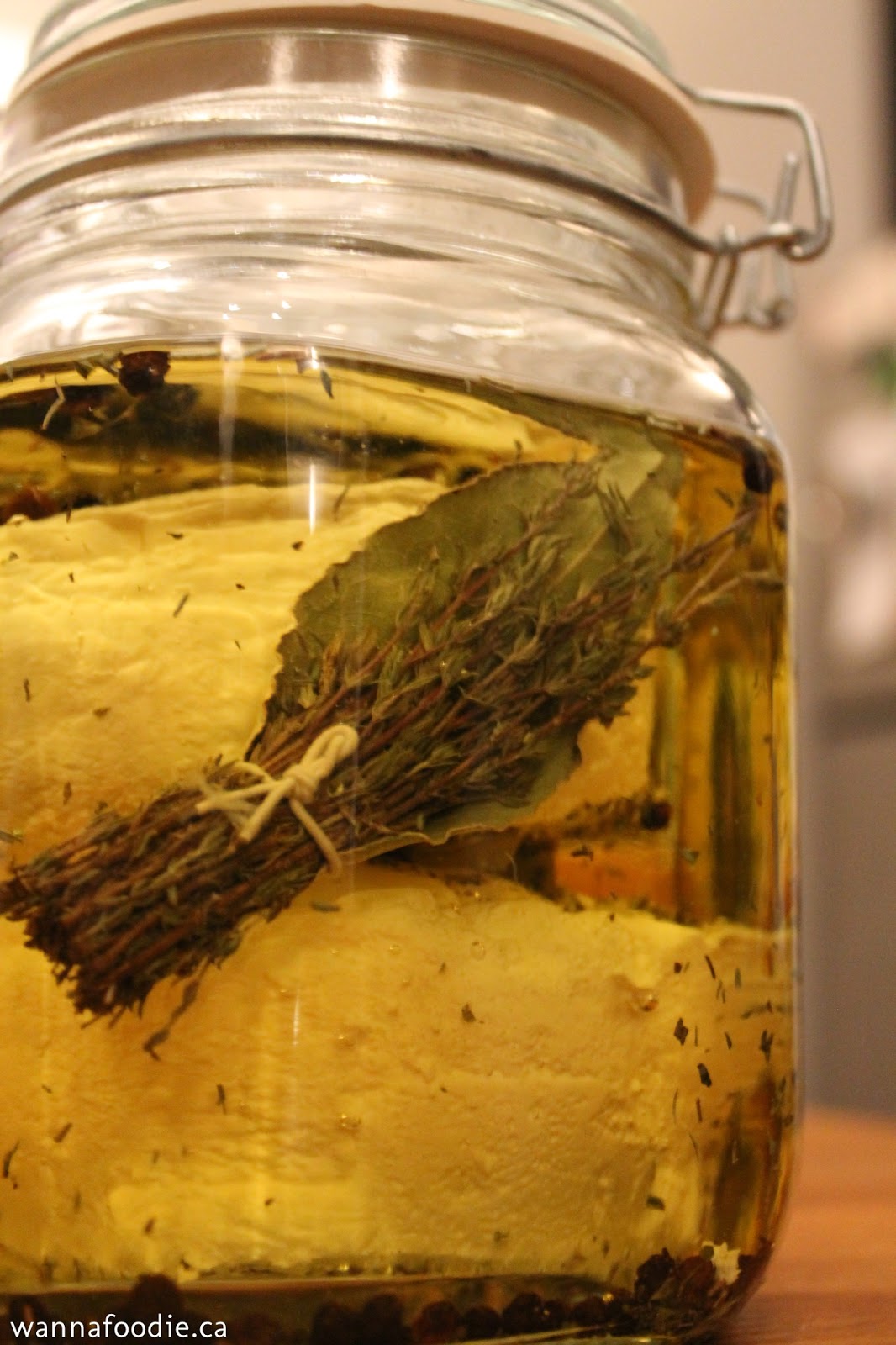
Cabecou is a classic French goat cheese that is formed into little rounds then aged or ripened for 10 to 15 days, according to our guide. It can be ripened into a soft spreadable cheese or left longer to reach a texture and firmness that you are able to grate. The one that caught my eye the most was the marinated version, which yielded both a supple and flavourful cheese as well as a fragrant oil that could be used for dipping or finishing. Though, after the success and rave reviews of the ricotta salata, I think I'm going to make not only the marinated version but also the dry salted versions again very soon.

Monday, October 8, 2012

Cheesepalooza: Ricotta Salata

Oh, ricotta salata... this is a cheese within a cheese. First, you need to make yourself some ricotta. You could opt for the whole milk ricotta or, as I did, you can build on flavour by utilizing whey ricotta. Then you salt and cure the ricotta to create a whole new cheese experience.

I made my whey ricotta using goat's whey and cow's milk, which made for a more complex yet still mild flavour profile. Since most commented that the ricotta salata was a fairly mild and innocuous cheese, I thought I would give it a bit more umph by using my combo whey ricotta.


So, once you've made your ricotta (in whatever form), you need to press it into a cheese mould, then salt it over the course of a week, then age it until it has reached whatever your ideal texture or density is, then eat it!

Cheesepalooza: DIY Cheese Moulds

Don't get me wrong, I love to throw myself into a project. I like to have all of the fancy supplies and gadgets. I try to not cut corners... mostly. :P I want to make an earnest effort and work hard to achieve the best result possible. All of that said, I had spent a few pennies purchasing the rennets and cultures and cloths required for the Cheesepalooza project but wasn't quite ready to purchase cheese moulds. Storage is at a premium in my small kitchen and I also wanted to be sure that, when I did purchase moulds, they would be moulds for cheeses that I would make again and again and again. Why buy a mould for a cheese that I didn't end up making or maybe didn't end up even liking?

So, I decided to DIY. Ian at Much Ado About Cheese has DIYed many of his cheesemaking supplies, so have Valerie, Addie, and Deb. I am reasonably handy... I can change light bulbs, assemble some Ikea furniture, and own a power drill. Ok, I'm not that handy and certainly a far cry from being a DIY Network star but I can get by. It was worth a few bucks and an attempt anyway...

I went off to the dollar store and found myself a few plastic BPA-free, food safe containers that I thought could function as reasonable moulds for my cheeses.

Cheesepalooza: Whey Ricotta

In making all of these cheeses, I have been left with an exorbitant amount of whey. Charlie the puppy absolutely loves this, as a bit of this on his kibble like cereal is enough to have him doing flips. The plants have loved it... though that season is coming to a close. I'm using it in bread. I can't quite get around to drinking it... just a mental block, I think. Maybe if I blend it into a smoothie?


One thing that I had to try in using up this whey was to make a whey ricotta. I thought I'd mix it up a little bit and make a whey ricotta using goat's milk whey and whole cow's milk.

I couldn't quite get the double-boiler bit coordinated... it's tough to find a pot big enough to fit a pot that fits two gallons of liquid! Instead, I opted for the single pot but warmed it extra slowly to compensate (it was more than 45 minutes to get to temperature).

The whole process was quite simple - heat, curdle, drain, cheese!

(It probably could have drained a weeeeee bit longer based on this photo...
but it was still soooooo good.)

Sunday, September 30, 2012

Cheesepalooza: Basic Chevre

While August and its ricotta zipped on by, September welcomed us with another Cheesepalooza challenge... a basic chevre. A basic chevre or goat cheese is another cheese that I enjoy (well... I can't really think of any cheeses that I don't enjoy) and was excited to give it a shot at home. Goat cheese is extremely flavourful, high in nutrients, reasonable in terms of fat and calories, and easier on the tummy for those individuals that have trouble with dairy (here are some interesting nutritional facts on goat cheese). All good things!


The directions for this cheese in Mary Karlin's book seemed simple enough - C20G, rennet, and your milk. Yep, simple enough until you realize that you neglected to order the C20G (a culture that is a combination of the bacterial cultures and rennet required to produce a goat cheese). Oh Christine. You'll laugh though, I had packed up my other cultures, thermometers, and cheese cloth on my September holiday (that's on your packing list too, right?). We were off to Ontario cottage country and I figured it would be a perfect time to rest, relax, and make cheese. But, when the closest town in 20 minutes away and the nearest goat's milk supply about 45 minutes away and you lack the correct cultures, the whole idea of zen-like cheese making whilst on holidays seems a bit silly. Just a bit... or a whole lot of silly?? 


Thankfully, our intrepid Cheesepalooza leaders reflected multiple methods in their individual chevre posts. Ian's post described a method using Aroma B and rennet. Deb's post followed the recipe precisely, while Valerie and Addie's posts highlighted buttermilk methods. (Plus, here is some good chevre reading on cheesemaking.com.) I was determined to figure something out too. 

Friday, August 24, 2012

Homemade Ricotta: Two Tastes

This whole escapade into homemade cheese has made me dream and concoct different combinations of flavours to create the perfect cheesy bite. When you put all of this effort into making your own cheese, you certainly don't want to see an iota of it go to waste. That said, there is only so much fresh plain ricotta that one can consume. I don't mean that to sound blasphemous, if you think it does! The 4.25 litres of milk and cream that I used to make my homemade ricotta yielded approximately 1.25 litres of cheese... and that's a lot of cheese!

So, I sat down with my new dedicated cheese journal and started jotting down potential flavour combinations. Then I grabbed my trusty Flavor Bible (if you aren't familiar with this reference book, I would highly recommend it) and went into flavour combination overdrive. What did I have in the house? What herbs were ample in the garden? Since it is such a subtle and mellow cheese, what would complement the ricotta without overpowering it?


These are the two bites that I landed on...
Fresh tarragon and lemon zest.
Cracked black pepper, fresh strawberry, and honey.

Wednesday, August 22, 2012

Cheesepalooza: Homemade Whole Milk Ricotta

I set some foodie goals back at the beginning of this year. It was a great way to focus my culinary efforts, learn some new things, and explore more of the food that I love. Well... one of those goals was to bake more bread and to learn to make cheese. 

Could the invitation to participate in Cheesepalooza have come at a better time!?!?


Well, Valerie of A Canadian Foodie, Deb the Locavore, Ian of Much Ado About Cheese, and Addie of The Big Cheese Project concepted and launched Cheesepalooza, a cheesy journey into the world of homemade cheese making. They invited and put an open call out to food bloggers from anywhere and everywhere to embark upon this cheesy journey together. With monthly challenges, optional extra creations and -of course- encouraged camaraderie and community learning, many signed up for Cheesepalooza. 

Our "curriculum" would follow through our guide book, Artisan Cheesemaking at Home by Mary Karlin - a beautiful book that seems to make the world of cheese-making infinitely more accessible than it was before I found this sort of structure for learning. Our first challenge for Cheesepalooza was issued at the beginning of August - to make a whole milk ricotta (check out the other challenges here). 
Related Posts with Thumbnails